
Official Course Descriptions and Learning Outcomes
Newgiza University (NGU) demonstrates a strong commitment to Education for Sustainable Development by integrating dedicated courses and modules that explicitly address sustainability and the United Nations Sustainable Development Goals (UN SDGs) across its undergraduate programs. These courses embed principles of environmental stewardship, climate action, water management, and socio-economic resilience within the disciplines of Engineering, Economics, and Information Technology, ensuring that students acquire the competencies needed to advance sustainable development in their professional fields.
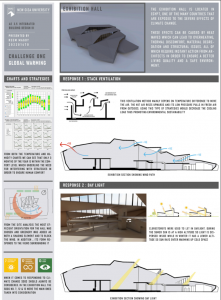
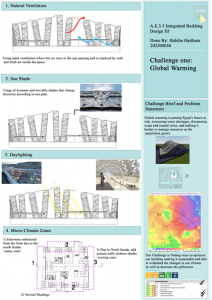
- NGU.AE.3.5 – Integrated Building Design III
School: Engineering
Credit Hours: 3 | Semester: Year 3, Semester 1
Focus:
- Application of green building principles and climate-resilient design within Egypt’s environmental and policy context.
- Integration of UN SDGs and Egypt’s National Climate Change Strategy in building design and planning.
- Emphasis on whole-building design, climate adaptation, LEED frameworks, and energy-efficient systems using tools such as REVIT Green Building Studio, Sketch-Up Predesign, and Climate Consultant.
Learning Outcomes:
- Develop sustainable architectural solutions responsive to climate change and urban resilience.
- Understand policy frameworks shaping Egypt’s built environment.
- Apply environmental science principles to architectural design and interdisciplinary collaboration.
Assessment: Coursework (35%), Midterm (30%), Final Exam (35%).
- NGU.EDP.4 – Engineering Design and Practice IV: Engineering in Society Scenario
School: Engineering
Credit Hours: 2 | Semester: Year 4, Semester 1
Focus:
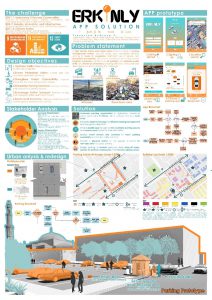
- A 2-week intensive interdisciplinary project addressing “wicked problems” aligned with the UN SDGs.
- Teams tackle real-world challenges such as rural energy access, urban transport congestion, and sustainable infrastructure.
- Projects developed in collaboration with industry, government, and NGO partners.
Learning Outcomes:
- Apply engineering and social science knowledge to complex sustainability challenges.
- Work effectively in cross-sectoral teams integrating policy, economics, and technology.
- Communicate sustainable design solutions through Innovation Showcase and expert panel pitch.
Assessment: Design Brief (30%), Shark Tank Pitch (20%), Innovation Showcase (50%).
- E 313 – Water Resources and Agriculture Economics
School: Economics and Politics
Credit Hours: 3 | Semester: Year 3, Semester 1
Focus:
- Examines the economic, environmental, and policy dimensions of sustainable agriculture and water resource management in Egypt.
- Covers Integrated Water Resources Management (IWRM), climate change adaptation, food security, and water pricing mechanisms.
- Explores national challenges like Nile water security, GERD implications, and agricultural policy reforms in line with SDG 2 (Zero Hunger) and SDG 6 (Clean Water and Sanitation).
Learning Outcomes:
- Evaluate agricultural and water policies using sustainability frameworks.
- Design economically viable and environmentally sound solutions for water scarcity and food insecurity.
- Apply case-based analysis to Egypt’s agricultural sustainability initiatives and climate resilience strategies.
Assessment: Midterm (15%), Quizzes (5%), Assignments & Portfolio (20%), Final Exam (60%).
- Industry-Integrated Learning and Sustainability Applications
School: Information Technology
Course Cluster: CSAI 390 – Industrial Training I | CSAI 391 – Industrial Training II | CSAI 490 – Senior Project I | CSAI 491 – Senior Project II
Focus:
- Real-world experiential learning through industry placements and applied innovation projects.
- Exposure to sustainability-driven challenges in computing, artificial intelligence (AI), and data systems.
- Collaboration with industry, NGOs, and government partners addressing digital sustainability, smart infrastructure, and resource optimization.
Learning Outcomes:
- Apply computing and AI solutions to sustainability issues in real industry contexts.
- Demonstrate interdisciplinary collaboration and problem-solving in sustainable technology applications.
- Translate academic learning into scalable, high-impact innovations supporting SDGs.