

Academics
Academics
School of Arts and Design
About the School:
The School of Arts and Design (SOAD) at Newgiza University (NGU) adopts contemporary pedagogical approaches in arts and design education. It seeks to employ advanced creative and design thinking methodologies to meet labor market demands by preparing qualified graduates in the fields of Interior Design, Fashion and Moda Design, Graphic Design and Advertising.
The School fosters a diverse community of Egyptian and international students aspiring to develop their critical and creative tools. By applying these skills to complex design and artistic tasks, students contribute to problem-solving and community service. To support this, the School provides state-of-the-art facilities, specialized laboratories, and studios equipped to enable students to conduct the creative and technical process with high efficiency.
A synergistic blend of instruction and mentorship is provided by a distinguished faculty of academics and industry experts. Their integrated efforts focus on equipping students with specialized knowledge, enabling them to gain professional expertise that stimulates advanced thinking, planning, and execution while supporting the ethos of lifelong learning.
Furthermore, the School emphasizes the integration of digital media and technological tools across its disciplines. This focus ensures mastery and proficiency within the professional market, while simultaneously instilling essential skills in communication, teamwork, and entrepreneurship.
The School is committed to cultivating an innovative environment that transcends traditional boundaries through an extensive network of international professional organizations and academic partnerships with global universities. These strategic alliances enhance student competencies, preparing them to compete effectively at local, regional, and international levels.
Vision:
To position the School of Arts and Design at Newgiza University as a leader in the evolution of arts and design, both regionally and globally.
Mission:
The School is dedicated to preparing the designer who is academically and artistically qualified to meet the evolving demands of local, regional, and international labor markets. It strives to empower graduates capable of harnessing their ideas, knowledge, and artistic skills to serve society and contribute to its progress, while innovating unconventional solutions through the strategic integration of modern media. Furthermore, the School fosters a culture of entrepreneurship and lifelong learning by providing distinguished academic, professional, and research programs in Interior Design, Fashion and Moda Design, Graphic Design and Advertising, Product Design, and Filmmaking, all conducted within a framework of profound respect for ethical and professional values.
Meet the Dean
Prof. Abeer Hassan Abdo Moustafa
Dean of the School of Arts and Design

Welcome to the School of Arts and Design at Newgiza University (NGU).
The School is led by its Founding Dean, a Professor of Advertising and Graphic Design and a distinguished member of the Arts and Music Education Sector Committee (2025). With a career spanning several prestigious leadership roles, she served as the Secretary of the Scientific Committee for Faculty Promotions in the Applied Arts Sector (2019–2022) and continues to serve as a Senior Reviewer for the National Scientific Committee across multiple cycles.
Academic Leadership & Quality Assurance
A recognized expert in educational excellence, she is a Certified Reviewer and Trainer at the National Authority for Quality Assurance and Accreditation (NAQAAE). Her leadership extends to international training as an IBCT Certified Trainer, having conducted high-level programs for Cairo University, Ain Shams University, Capital University and the National Defense College. She has also played a pivotal role in the Ministry of Higher Education’s strategic development projects.
Strategic Impact & Policy Development
Beyond academia, her expertise has significantly shaped national regulations. She proposed the legislative amendments that led to the enactment of Law No. 208 of 2020 for roadside advertising. As a Strategic Consultant, she has developed regulatory frameworks and advertising policies for major national infrastructure projects and state institutions.
Research & Artistic Practice
An accomplished scholar and practitioner, she has published over 65 research papers and supervised more than 70 Master’s and Doctoral theses. Her professional portfolio includes designing corporate identities for various public and private organizations, alongside active participation in art exhibitions and Egyptian artistic syndicates. Throughout her career, she has been honored with numerous shields of excellence and awards for her contributions to both the academic and professional design communities.
At NGU, she continues to foster an environment where scientific research meets creative practice, ensuring that every student is equipped to become a pioneering “artist-designer.”
SOAD Strategic Objectives
The School of Arts and Design at Newgiza University (NGU) is dedicated to providing an exceptional standard of education, aiming to develop creative designers capable of fulfilling specialized artistic, design, and production requirements both within Egypt and internationally. The School’s objectives are summarized as follows:
- Delivering Academic Excellence: Providing distinguished educational programs that meet international benchmarks in arts and design.
- Cultivating a Supportive Environment: Establishing an integrated educational and administrative ecosystem that fosters student success and growth.
- Strengthening Strategic Partnerships: Leveraging collaborations with specialized academic and professional institutions to bridge the gap between education and the labor market.
- Empowering Personal and Professional Growth: Encouraging self-directed and lifelong learning, while enhancing research skills, entrepreneurship, creative thinking, and character building.
- Investing in Faculty Development: Ensuring the continuous professional and academic advancement of faculty members and the supporting staff.
- Fostering Community Engagement: Maintaining proactive and sustained communication with both current students and alumni.
- Social Responsibility and Impact: Actively serving the community and creating a meaningful, positive influence on the surrounding environment.
- Ensuring Quality and Sustainability: Implementing rigorous quality assurance standards to guarantee the excellence and long-term sustainability of the School’s offerings.
SOAD Values
The School of Arts and Design at Newgiza University (NGU) operates in accordance with the following fundamental values:
- Honesty: Upholding truthfulness and transparency in all academic and artistic endeavors.
- Respect: Fostering an environment of mutual appreciation among students, faculty, and the community.
- Integrity: Adhering to the highest ethical standards and professional principles.
- Discipline: Maintaining a commitment to rigor, responsibility, and academic excellence.
- Compassion: Cultivating empathy and social awareness within the creative process.
- Fairness: Ensuring equity, justice, and equal opportunities for all members of the institution.
- Diversity & Intellectual Freedom: Embracing differences and safeguarding the right to independent, critical thought.
- Excellence: Striving for the highest quality in education, research, and creative output.
- Creativity: Encouraging innovation and original thinking as the cornerstone of arts and design.
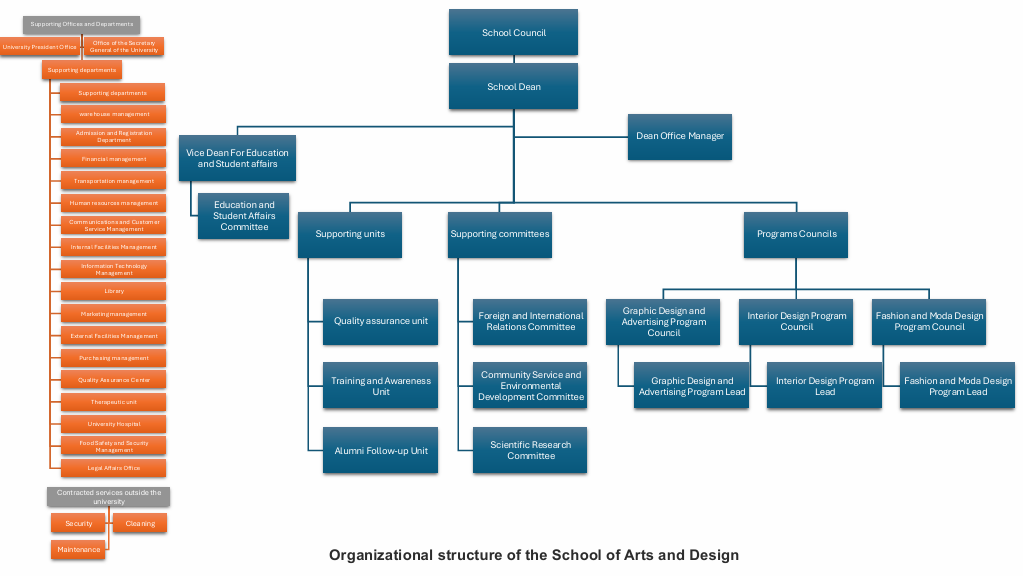
Organogram
Academic Programs
Shape the Future of Design: Our Creative Programs
Welcome to the hub of innovation and visual excellence. Our design programs are meticulously crafted to merge artistic mastery with cutting-edge technology, transforming your creative passion into a professional powerhouse.
Choose your path and start building the world of tomorrow, and explore our three programs:
- Graphic Design & Advertising Program: Master the art of visual dominance. From harnessing AI-powered design tool, creative branding to immersive digital storytelling, learn to create high-impact campaigns that command attention and drive the global conversation.
- Fashion and Moda Design Program: Step into the heart of the industry. Combine textile innovation with creative expression to build a sustainable and visionary career in the global fashion market.
- Interior Design Program: Redefine the environment around you. Learn to blend functionality with aesthetics to create inspired, human-centric spaces for the modern world.
Ready to lead the industry? Explore our programs below.
Graphic Design and Advertising Program
The Graphic Design & Advertising program is a multidisciplinary journey that bridges the gap between creative artistry and strategic communication. By integrating human sciences with innovative technology, our program empowers students to design impactful visual experiences that balance aesthetic value with functional efficiency. We focus on developing professional designers who are not only technically proficient in industry-standard tools but are also critical thinkers capable of solving complex problems through systematic research. With a strong emphasis on professional ethics, cultural awareness, and social responsibility, our graduates are prepared to lead in the global creative market, adapting their personal vision to meet evolving industry demands and community needs.
Graphic Design and Advertising Program Mission:
The program is dedicated to preparing creative graphic designers and advertising professionals who possess the artistic and technical proficiency to meet the evolving demands of the local and international creative industries. By fostering a culture of scientific and applied research, the program empowers students to harness visual communication tools and modern digital media to innovate unconventional branding and advertising solutions. It ensures graduates are capable of leading impactful visual campaigns and contributing to the advancement of the field through inquiry and entrepreneurship, all within a framework of ethical and professional values.
Key Learning Outcomes
- Technical Proficiency: Advanced skills in industry-standard software.
- Creative Problem Solving: Applying design thinking to solve marketing challenges.
- Brand Communication: Designing to meet client objectives and target audience needs.
- Pre-press & Production: Preparing files for print and digital output.
- Career Development: Enhancing employability skills.
Career Paths
Graduates work in various bodies, ministries, public bodies, and private offices, publications, advertising agencies or in-house marketing teams as well as doing free artistic work.
In addition to working as graphic designers, advertising designers, art directors, creative directors, brand specialists, storyboard/comics designers, game designers, printed media and publication designers, typographers and UX/UI designers.
General Objectives:
- Interdisciplinary Design Integration: Synthesize knowledge from various sciences (such as psychology, sociology, and marketing) to develop holistic visual communication solutions.
- Creative Design Innovation: Innovate advertising products that achieve a perfect balance between artistic aesthetics and functional performance.
- Resource Optimization: Demonstrate the ability to manage and utilize technical and human resources efficiently within the creative production workflow.
- Life-long Learning & Adaptability: Foster the capacity for self-directed learning to stay current with the rapidly evolving trends in design technology and advertising media.
- Professional Versatility: Adapt individual creative styles and personal expertise to meet diverse industry requirements and client specifications.
- Professional Ethics & Media Law: Adhere to the legal frameworks, copyrights, and ethical standards governing the graphic design and advertising industry.
- Global Cultural Awareness: Engage with diverse visual cultures and artistic movements to enhance the impact of designs in a globalized market.
- Design Research Methodology: Apply systematic research and critical thinking to analyze design problems and formulate creative, evidence-based solutions.
- Social Responsibility & Community Impact: Engage positively with civil society by designing social-impact campaigns that address community needs and values.
- Advanced Technological Application: Leverage cutting-edge digital tools and emerging technologies to solve complex design challenges and enhance production quality.
Program Core Curriculum
- Foundations of Design: Principles of Design, Color Theory, Typography, Engineering Drawing, History of Art & Design, History of Graphic Design, Basic Drawing, Creative Thinking,Visual Culture.
- Technical Skills: Mastery of Adobe Illustrator, Photoshop, InDesign, Maya, After effect and other technical softwares,
- Advertising & Marketing Strategy: Advertising, Brand Identity, Marketing, Visual Communication.
- Design Specializations:
- Editorial & Publication Design: Layout for magazines and books.
- Packaging Design: Creating 3D retail, product packaging.
- Digital & Motion Graphics: Website design, UI/UX, and social media content.
- Photography, Filmmaking, VFX & Illustration: Digital imaging techniques.
- Game Design & Animation: Design a game, storyboarding, stop-motion and character animation, animation techniques.
- New Media Design and Experiential Graphic Design: creative solutions for digital mediums unity, digital platforms, wayfinding, interpretation, exhibit design and signage.
- Information and Infographics Design: information visualization, infographic narratives.
- Professional Development:
- Portfolio Development: Creating a professional portfolio (Behance, personal website).
- Studio Projects & Internships: Hands-on experience with real-world clients.
- Design Management & Entrepreneurship: design/business relationship.
- Intellectual Property Rights for Artists and Designers: intellectual property enforcement, ownership and authorship of creative works, copyright, trademark, and other relevant legal issues.
- Senior Thesis/Project: Final, comprehensive design campaign.
Fashion and Moda Design Program
The Fashion and Moda Design Program stimulates creative expression in all key aspects of business and innovation in the fashion and moda industry and successfully equips students to enter the fashion world through an encouraging academic environment. It also focuses on experiential learning to provide students with the tools they need to succeed as fashion and moda professionals.
The philosophy of the program is to be unique and encourage personal guidance by preserving the identity of future designers to implement successful creative ideas in the field of fashion and moda which prepare a designer with competitiveness and creativity in the business market on strong scientific and practical grounds and by integrating fashion science with various modern sciences, complementing theoretical understanding with practical application of ways of implementing fashion and moda products.
The program develops self-learning skills that develop students’ minds and abilities for creativity and innovation and equip them with the skills and abilities necessary for self-employment and the creation of new jobs. It also develops awareness of the changing influences of fashion trends and forces within the fashion industry, in addition to studying the fundamentals of marketing through a diverse methodology that evaluates and analyses conceptual developments regarding the promotion of the future direction.
Fashion and Moda Design Program Mission:
The program is committed to preparing pioneering fashion designers who are qualified to compete in the regional and international fashion industries. The program emphasizes the integration of scientific research with creative practice, focusing on blending traditional craftsmanship with cutting-edge technological media to address contemporary market trends. By nurturing original expression, entrepreneurial skills, and a research-oriented approach to cultural heritage, the program empowers graduates to contribute to the progress of the fashion industry while upholding professional ethics.
Key Learning Outcomes
- Technical Proficiency: Mastery of industrial sewing machinery, pattern drafting, jewelry crafting, tools and fashion design software.
- Trend Analysis: Ability to research and predict global trends to inform creative directions.
- Garment Construction: Translating 2D sketches into high-quality 3D wearable garments with precise fit.
- Brand Strategy: Developing a unique design DNA and marketing it to specific target audiences.
- Brand Communication: Developing unique brand identities for fashion and jewelry labels.
Career Paths
Graduates work as fashion designers, jewelry designers, creative directors, fashion stylists, pattern makers, fashion buyers, and merchandisers for international fashion houses or as independent entrepreneurs launching their own labels. The program provides job opportunities in many fields, including fashion design, fashion industry, accessories design and fashion supplements, work in specialized research centers, self-employment in the areas of small enterprises in the production of clothing, work in quality control and development centers, administrative work at major clothing companies and factories, planning and production management, marketing and sales.
General Objectives:
- Interdisciplinary Integration: To synthesize diverse scientific and theoretical knowledge and apply it effectively within the design and production processes of fashion and jewelry.
- Aesthetic & Functional Innovation: To foster creativity in developing fashion products and accessories that balance high artistic value with practical functionality.
- Resource Optimization: To ensure the sustainable and efficient utilization of materials and available resources throughout the design and manufacturing stages.
- Lifelong Learning: To empower students with self-learning capabilities and a commitment to continuous professional and academic development.
- Professional Adaptability: To translate personal creative experiences and individual talents into practical skills that meet evolving labor market requirements.
- Legal & Ethical Awareness: To familiarize students with the laws, legislations, and ethical standards governing the fashion and jewelry industry.
- Cultural Literacy: To promote deep understanding and engagement with global artistic cultures and diverse aesthetic heritage.
- Scientific Research & Problem Solving: To adopt systematic scientific thinking and rigorous methodologies in conducting research and addressing design challenges.
- Social Responsibility: To engage positively with civil society institutions by identifying and fulfilling their needs through design solutions.
- Technological Application: To leverage and apply appropriate modern technologies to enhance production quality and solve complex design problems.
Program Core Curriculum
- Foundations of Fashion: Principles of Design, Color Theory for Textiles, History of Costume, and Fashion Psychology.
- Technical & Digital Skills: Fashion Illustration (manual and digital using Adobe Illustrator/Photoshop), Flat Pattern Making, and 3D Garment Simulation (CLO 3D)
- Textiles & Material Science: Study of Fibers, Fabric Construction, Dyeing Techniques, Metals for Jewelry, and Sustainable Sourcing.
- Fashion Specializations:
- Ready-to-Wear (RTW): Designing for mass production and commercial retail.
- Haute Couture & Tailoring: Advanced draping, couture sewing techniques, and embellishment.
- Sustainable Fashion: Eco-friendly materials and ethical manufacturing.
- Fashion Accessories: Design and prototyping for footwear, handbags, and jewelry.
- Professional Development:
- Portfolio Development: Creating a professional design portfolio and digital lookbooks.
- Fashion Marketing & Merchandising: Brand identity, retail management, and consumer behavior.
- Senior Thesis/Project: A comprehensive collection of fashion and accessories items.
Interior Design Program
Interior design is a multifaceted discipline in which creative and technical solutions are applied within a structured framework to achieve a suitable interior environment. The program focuses on preparing the interior designer who combines knowledge, creativity, problem-solving skills, and aesthetic vision to provide environments that are safe, practical, aesthetic, and meet needs.
The program includes specialized knowledge and skills in different design trends, interior space planning, building codes, materials, and furniture design and production. The program also focuses on applications of design theory and preservation of historical identity, sustainable design, technology, and the quality of the indoor environment. It also develops the student’s research and analytical capabilities and encourages experimentation and discovery, in addition to developing self-learning skills and the abilities necessary for self-employment, so that the graduate becomes a producer of job opportunities and not a seeker of them.
Interior Design Program Mission
The program aims to develop professional interior designers who balance artistic vision with technical expertise to meet the functional and aesthetic needs of the global design market. It strives to equip students with the skills to transform spaces through innovative, sustainable, and human-centric design solutions grounded in rigorous scientific research and design methodologies. By integrating advanced planning, modern materials, and research-driven practices, the program prepares graduates to enhance the built environment and serve society as creative leaders and lifelong learners.
Key Learning Outcomes
- Spatial Proficiency: Advanced ability to optimize floor plans and solve complex structural challenges.
- Technical Execution: Preparing professional working drawings, specifications, and bill of quantities (BOQ).
- Human-Centric Design: Applying ergonomics and human factors to enhance user comfort and safety.
- Concept to Reality: Translating abstract client visions into tangible, functional, and aesthetic environments.
- Career Development: Enhancing employability skills
Career Paths
Graduates work as interior designers, furniture designers, lighting specialists, kitchen designers, or project managers in design firms, real estate development, and retail visual merchandising. The program provides job opportunities in many fields, including companies and consulting firms in interior design, design, planning, quality control, and inspection (in the field of interior design). It also prepares graduates to work in various types of interior design, including residential, commercial, hotel, tourism, healthcare, industrial, cultural, and entertainment design, as well as in technical offices for interior design and furniture production factories and companies (in design, production, quality control, and inspection). In addition, graduates can work in producing virtual snapshots of the projects they design, cultural coordination and planning, entrepreneurship and consulting related to the specialization, research and development bodies and design centres, and interior design work for cinematic, theatrical, and television scenes in various artistic productions.
General Objectives:
- Interdisciplinary Integration: To integrate various sciences and theoretical knowledge with practical design and production processes to create cohesive interior environments.
- Innovative Problem-Solving: To foster innovation in designing furniture and interior products that balance aesthetic excellence with ergonomic and functional values.
- Resource Optimization: To develop the ability to utilize material and human resources optimally, ensuring efficiency and sustainability in design execution.
- Lifelong Learning & Adaptability: To equip students with self-learning skills and a commitment to continuous professional development to keep pace with the evolving design industry.
- Professional Versatility: To enable students to adapt their personal creative experiences and technical expertise to meet diverse professional market requirements.
- Regulatory Compliance: To instill a deep understanding of the laws, building codes, and professional legislations governing the interior design and furniture industry.
- Cultural & Aesthetic Awareness: To promote an appreciation for diverse artistic cultures and aesthetic trends, enabling meaningful interaction with global and local design heritage.
- Methodological Research: To train students in scientific thinking and systematic research methodologies for analyzing and solving complex design challenges.
- Social Responsibility: To encourage positive engagement with civil society institutions by providing design solutions that meet community needs and enhance quality of life.
- Technological Proficiency: To empower students to apply cutting-edge technologies and digital tools in design modeling, manufacturing, and problem-solving.
Program Core Curriculum
- Foundations of Design: Principles of Interior Design, Color Theory, Spatial Psychology, and Perspective Drawing, Engineering/Architecture Drawing, History of Art & Design, History of Interior Design, Basic Drawing, Creative Thinking, Ergonomics.
- Technical Skills: Mastery of 2D Drafting and 3D Modeling Software (AutoCAD, Revit, 3ds Max, and V-Ray), Adobe Photoshop and other technical softwares.
- Materials & Technology: Study of Finishing Materials, Textile Science, Lighting Systems, and Building Services (HVAC, plumbing).
- Design Specializations:
-
- Residential Design: Planning and styling for private villas, apartments, and smart homes.
- Commercial & Hospitality Design: Layouts for offices, retail stores, restaurants, and hotels.
- Furniture Design: Concept development and construction of bespoke and mass-produced furniture.
- Sustainable & Universal Design: Eco-friendly materials, energy efficiency, and accessibility (ADA) standards.
- Professional Development:
-
- Portfolio Development: Compiling a professional design portfolio featuring renderings and technical shop drawings.
- Studio Projects & Internships: Hands-on experience within architectural firms or furniture manufacturing plants.
- Senior Thesis/Project: A final, comprehensive interior solution from conceptualization to detailed execution plans.
Study System
Credit Hour System:
All academic programs at the School operate under the Credit Hour System. The academic degree is awarded once the student fulfills all graduation requirements in accordance with the School’s bylaws and the resolutions of the School Council.
Total Credit Hours:
A total of 144 credit hours is required for graduation.
Academic Workload:
Students are permitted to register for a minimum of 12 credit hours and a maximum of 18 credit hours per semester.
Summer Semester:
The School may offer summer semesters with a maximum of 8 credit hours per semester to assist students in fulfilling their credit requirements. Course offerings and minimum enrollment thresholds are determined by the School. Enrollment in summer semester is subject to additional fees.
Practical Training (Field Practices):
- Successful completion of practical training is a mandatory requirement for graduation. These hours are not calculated as part of the total 144 credit hours required for the degree.
- Based on the proposals of the Academic Program Councils, the School Council shall establish a formal system for student practical training (conducted either internally or externally). These hours do not count toward the academic credit hours and require the payment of prescribed fees upon registration.
Graduation Requirements (Non-Credit Courses):
- Graduation requirements include specific courses mandated by the Supreme Council of Universities, such as the “Societal Issues”. While these are essential for the conferral of the degree, they are not counted toward the total required credit hours, nor are they included in the calculation of the Semester GPA or Cumulative GPA (CGPA).
- Enrollment in these courses requires the payment of prescribed fees.
- International students are exempted from these specific graduation requirement courses.
International Collaboration & Validation
 Milano Fashion Institute (MFI)
Newgiza University (NGU) offers creative programs that have been successfully validated by the prestigious Milano Fashion Institute (MFI). NGU has developed world-class curricula for the following programs:
- Fashion Design
- Interior Design
- Graphic Design and Advertising
Standards of Excellence:
Milano Fashion Institute has conducted comprehensive advisory activities to ensure that NGU’s academic offerings comply with the highest international standards of excellence. This validation covers critical academic pillars, including:
- Curriculum & Roadmap: Strategic alignment of courses, learning outcomes, and timetabling.
- Academic Quality: Assessment of faculty expertise, course materials, and evaluation tools.
- Industry Relevance: Ensuring the programs bridge the gap between academic theory and the global creative industry.
- Learning Experience: Optimization of both direct lectures and self-directed learning activities.
Through this partnership, NGU ensures its students receive a globally recognized education that is deeply connected to the heart of Italian design expertise and international market demands.
ON DEMAND ACTIVITIES:
- Exchange Program: Semester abroad
- Fashion Experience/Summer School
- Personal Branding Mentorship
- Online Career Day
Global Cooperation Agreements
 CY Cergy Paris Université
Newgiza University (NGU) maintains a strategic academic partnership with CY Cergy Paris Université, offering students and faculty diverse opportunities for international exposure and academic growth:
- Student Exchange Programs: Students can broaden their academic horizons by participating in exchange programs lasting for one or two semesters, experiencing a world-class educational environment in France.
- CY Tech Summer School: NGU students have the exclusive opportunity to join the prestigious CY Tech Summer School every July. These intensive programs last from two to four weeks and cover specialized themes designed to enhance technical and creative skills.
- Faculty & Staff Mobility: The partnership facilitates the exchange of professors and administrative staff, promoting collaborative teaching, joint research initiatives, and the sharing of global best practices in university management and pedagogy.
 National Research Centre (NRC)
Newgiza University (NGU) maintains a robust partnership with the National Research Centre (NRC), fostering a dynamic environment for scientific and applied excellence. This collaboration spans several key pillars:
- Joint Research & Funding: Collaborating on integrated research projects to leverage local and international funding opportunities.
- Technology Transfer: Facilitating the exchange of technological innovations between both institutions and the industrial sector.
- Academic Exchange: Promoting the mobility of students, scientists, and subject matter experts to enhance knowledge sharing.
- Joint Supervision: Providing mutual academic supervision for Master’s and PhD theses, ensuring high-level research mentorship.
- Education & Training: Organizing joint conferences, workshops, and seminars, as well as specialized training programs at the NRC for postgraduate students in rare disciplines.
- Resource Sharing: Granting students access to the NRC’s extensive scientific library, including specialized books, periodicals, and dissertations.
- Strategic Faculty Collaboration: Encouraging faculty members from both sides to participate in applied research aligned with the state’s strategic priorities.
- Laboratory & Facility Access: Maximizing research output by providing reciprocal access to advanced laboratories and scientific facilities for both NGU and NRC affiliates.
Student Mobility & Exchange
- Credit Transfer and External Enrollment:
Students may enroll in courses offered by external faculties, universities, or recognized international institutions. Such courses may be credited toward the student’s degree program provided that the course content is verified and approved by the School Council, based on the recommendation of the respective Academic Program Administration. Credits earned through this process are included in the calculation of the Cumulative Grade Point Average (CGPA), provided that the total number of these external credits does not exceed 25% of the total hours required for graduation.
- Visiting Student Policy:
A Visiting Student is defined as an external student who enrolls in specific courses at the School without the intent of obtaining a degree. Admission as a visiting student is subject to the review of the Academic Programs Administration, the approval of the Dean, and compliance with the regulations established by the School Council.
The maximum academic workload for a visiting student is 18 credit hours during a regular semester and 8 credit hours during a summer session. Upon successful completion of the enrolled courses, the student shall be issued an official certificate stating the courses taken and the grades achieved.
Entrance Requirements
Tuition Fees & Deadlines
Tuition Fees:
The School of Arts and Design tuition fees for the academic year (2026-2027): 258,200 EGP + 750 USD for Egyptian students. For more information, please click here.
Deadlines:
The deadline for the academic year 2026/2027 will be announced soon.
Apply Now
Fill out the online application form.
For admissions inquiry, please contact 16623, or email enrollment@ngu.edu.eg