

Academics
Academics
School of Economics and Politics
About the School:
The School of Economics and Politics (SOEP) welcomed its inaugural intake of students in the academic year 2019/2020. The school aspires to become the leading educational institution for Economics and Politics in the MENA region.
Mission:
The school’s mission is to strive for excellence in higher education and scientific research by attracting top students and preparing competent, adaptable, and competitive graduates. These graduates will be equipped with strong research skills, well-versed in modern economic analysis tools, capable of formulating policies and making sound economic decisions, and knowledgeable about research methodologies in political science and international negotiation mechanisms.
Additionally, the school aims to graduate students who can keep pace with the continuous changes in the economic and political arenas, represent Egypt in international organizations and forums, and actively participate in political life.
Vision:
To create a community of interdisciplinary researchers, professors, and students who foster excellence and encourage innovation. This community will spearhead academic and scientific advancement in the region and around the world by building a solid foundation for 21st-century learning.
Meet the Dean
Prof. Hala Sakr
Dean of the School of Economics and Politics
Prof. Hala Mohamed Sakr is a Professor of Economics at the Faculty of Economics and Political Science (FEPS), Cairo University, a position she has held since 2015. She served as the Academic Coordinator of the English Section from 2015 to 2018 and was a member of the Steering Committee for the implementation and supervision of the Credit Hours System at FEPS. She is currently a member of the Technical Committee for the Health Economics Professional Master’s program.
She represents FEPS on the Economic Committee of the EU Tuning Africa Initiative Project, under the supervision of Deusto University (Spain), the African Commission, and the European Union.
Prof. Hala has been a member of the Travel and Tourism Sub-Council of the Egyptian National Competitiveness Council (ENCC) since 2013. In 2016, she provided economic consultancy to the Egyptian Competition Authority (ECA). She also served as a Monitoring and Evaluation expert for the Health Pillar of Egypt’s 2030 Sustainable Development Strategy (SDS) at the Ministry of Planning, Monitoring and Administrative Reform (MPMAR) in 2017.
Throughout her academic career, she has published several papers on foreign direct investment, trade in services, labor migration, local economic development, inclusive growth, the tourism sector, health sector liberalization, and the knowledge economy.
Prof. Hala’s teaching experience includes Macroeconomics, Microeconomics, Economic Development, International Economics, Managerial Economics, Health Economics, and the Knowledge Economy.
SOEP Strategic Goals
- Enhancing the School’s academic competitiveness by offering internationally accredited educational programs that align with the latest global standards, in partnership with leading educational institutions.
- Graduating academic and professional cadres characterized by creativity, critical thinking, and leadership in their respective fields through the development of personal and scientific skills.
- Strengthening the School’s status as an internationally oriented educational institution that attracts students from around the world, thereby promoting cultural diversity and academic excellence.
- Building a leading research environment that supports innovation and knowledge and contributes to the production of impactful scientific research at both the local and regional levels.
- Activating the role of the School as a developmental institution that contributes to community service through effective and sustainable partnerships with civil society organizations and with both the public and private sectors.
SOEP Strategic Objectives
- Increasing and strengthening academic cooperation agreements with internationally ranked universities.
- Offering joint or dual academic programs in collaboration with foreign universities.
- Enhancing students’ cognitive skills across all courses and academic years.
- Strengthening academic advising and providing support for struggling students.
- Organizing scientific seminars and symposia to raise student awareness of political and economic issues.
- Establishing training partnerships with ministries, research centers, and international institutions.
- Providing students with opportunities to travel abroad to enhance their academic experience and benefit from international educational opportunities.
- Offering scholarships to international students and assigning teaching assistants to support them during their studies.
- Delivering integrated educational programs while emphasizing community service.
- Implementing the School’s research plan.
- Establishing a scientific research center that contributes to the development of research in Egypt and the region.
- Organizing seminars and conferences with the participation of representatives from civil society organizations and other stakeholders.
SOEP Values
- Excellence
- Innovation
- Diversity
- Quality
- Social Responsibility
Organogram
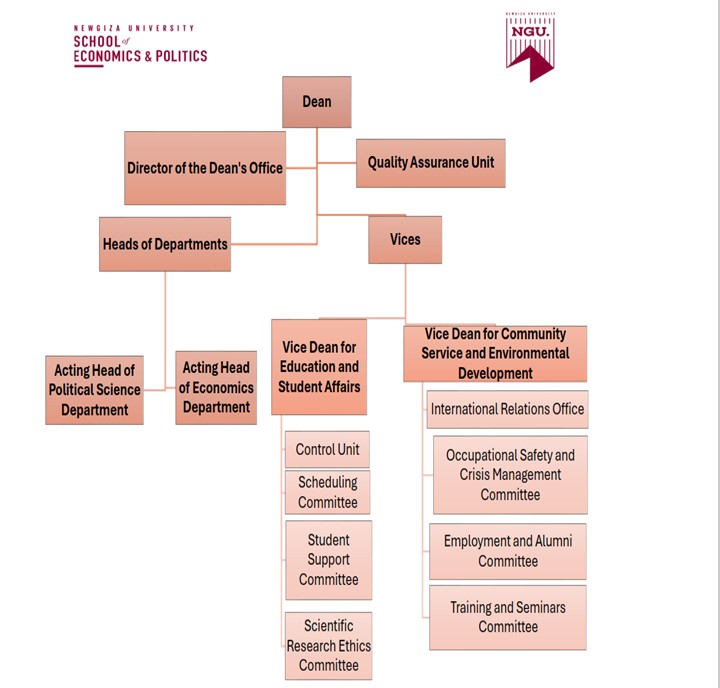
Accreditation & Academic Collaboration
Accreditation:
Newgiza University (NGU) was established as a private university by a presidential Decree “93” in April 2010. NGU schools were acknowledged by the Ministry of Higher Education (MHE) and the Supreme Council of Universities (SCU).
The university will eventually include twelve schools: Medicine, Pharmacy, Dentistry, Nursing and Health Science, Economics and Politics, Law, Business and Finance, Engineering, Information Technology, Arts and Design, Archaeology, and Languages and Interpretation. Currently, eight schools are functioning: Medicine, Dentistry, Pharmacy, Business and Finance, Economics and Politics, Engineering, Information Technology, and Arts and Design.
The School of Economics and Politics was acknowledged by decree “4556” in October 2019. Every school will apply for accreditation by National Authority for Quality Assurance and Accreditation in Education (NAQAAE) after the graduation of the first batch.

Academic Collaboration with King’s College London (KCL) (2019-2024):
Newgiza University (NGU) engaged in a strategic academic collaboration with King’s College London to support the establishment of the School of Economics and Politics. This collaboration was instrumental in shaping the academic vision, structure, and standards of the School.
During this foundational period, senior academics and administrators from King’s School of Politics and Economics worked alongside NGU leadership to design and develop a contemporary undergraduate program aligned with international best practices. Their contributions included support in strategic planning, governance frameworks, curriculum design, learning resource development, faculty recruitment, faculty capacity building, and the implementation of robust quality assurance systems.
As one of the United Kingdom’s leading universities, King’s College London brought global expertise and academic excellence to the developmental phase of the School.
While the collaboration has concluded, its impact remains embedded in the School’s academic framework, program design, and commitment to delivering high-quality education grounded in international standards.
Why NGU's School of Economics and Politics?
The School of Economics and Politics (SOEP) at NGU seeks to develop the educational process in the fields of economics and politics in line with the ongoing changes in these fields at both the local and global levels. Moreover, it aims to enhance the level of practical training for its students, enabling them to secure the best job opportunities domestically and internationally. The school also strives to create a generation of students who possess the energy, talent, and ability to think critically and to find solutions to economic, political, and cultural problems.
Why Choose NGU’s School of Economics and Politics?
At NGU’s School of Economics and Politics, we prepare future leaders through academic excellence, practical experience, and global exposure.
- Academic Excellence
Our Economics and Politics majors are taught by distinguished professors and field experts who combine strong academic credentials with real-world insight. Students benefit from rigorous theoretical foundations while engaging with contemporary economic challenges, public policy issues, and political dynamics at both local and international levels. - Exceptional Internship Opportunities
SOEP provides diverse internship opportunities with leading institutions, organizations, and banks, giving students valuable hands-on experience and professional networks prior to graduation. These opportunities include placements with institutions such as the Egyptian Exchange (EGX), the Egyptian Competition Authority (ECA), the Financial Regulatory Authority (FRA), Ezz Steel, the League of Arab States, the National Council for Human Rights, and Together Inclusive (NGO).
International Partnerships & Programs
Complutense University of Madrid – Strategic Academic Partnership
The School of Economics and Politics has established a strategic academic partnership with GEIS-UCM at Complutense University of Madrid through a formal Memorandum of Understanding (MoU).
This collaboration advances joint research, academic exchange, and high-impact publications in international security, geopolitics, and strategic studies, expanding global opportunities for NGU’s academic community.
CY Cergy Paris University – Exchange Program
The School of Economics and Politics has established an exchange partnership with Sciences Po Saint‑Germain‑en‑Laye, part of CY Cergy Paris University, offering opportunities for both students and staff to participate in international mobility programs.
This collaboration supports one- or two-semester exchanges, promoting global learning, research, and cross-cultural engagement.
Philipps University Marburg – Summer Program
The School of Economics and Politics offers a summer program in collaboration with Philipps University in Marburg, Germany, providing students with international learning opportunities and academic enrichment.
The program allows students to engage with global perspectives and experience an international academic environment.
Program Summary
The four-year bachelor’s program is designed to provide society with highly qualified graduates in both Economics and Politics. The program will enable students to fully understand economic and political problems and challenges at the national, regional, and international levels, and to acquire and apply various analytical and quantitative tools as well as negotiation skills. These skills will ultimately enable students to compete at the international level. This will be achieved through both a solid academic background and the acquisition of 21st-century soft skills.
The program also adopts various student assessment methods, such as:
- Formative assessments: Based on continuous, non-graded evaluation of students during each semester through post-lecture quizzes and role plays.
- Summative assessments: Graded evaluations of students at the end of each semester, including coursework, research papers, presentations, discussions, as well as written examinations (midterm and final exams).
Program Structure
The School of Economics and Politics is currently delivering Bachelor of Economics as well as Bachelor of Political Science. Each bachelor requires the completion of 144 credit hours (equivalent to 48 courses) distributed among four academic years as follows:
Year 1: 36 credit hours equivalent to 12 compulsory courses (Principles of Macroeconomics- Principles of Microeconomics- Principles of Mathematics- Principles of Political Science (1)- Principles of Political Science (2)- Principles of Statistics (1)- Principles of Statistics (2)- Commercial and Corporate Law- Egyptian Economic System- Egyptian Political System- Principles of Management-Social Computing).
Economics Program:
Year 2: 36 credit hours equivalent to 9 compulsory courses (Macroeconomics Theory (1)- Microeconomics Theory (1)- Money and Banking- International Economics- Financial Accounting- Statistics for Economists (1)- Statistics for Economists (2)- Mathematics for Economists(1) – Mathematics for Economists (2) ) and 3 elective courses to be chosen from (Economics of Egypt- Industrial Organization- Political Economy- Managerial Economics -Principles of Marketing).
Year 3: 36 credit hours equivalent to 8 compulsory courses (Macroeconomics Theory (2)- Microeconomics Theory (2)- Public Finance-Financial Economics-Mathematical Economics (1)-Econometrics (1)- Research Methodology- Economic Development) and 4 elective courses to be chosen from (Experimental Economics- Environmental Economics- Economic Policy-Knowledge Economy-Water Resources and Agricultural Economics- Economics of Energy- The World Economy- Theory of Economic Growth).
Year 4: 36 credit hours equivalent to 8 compulsory courses (Institutional Economics-Research Seminar, Graduation Project on the Egyptian Economy-History of Economic Thought- Project Evaluation- Econometrics (2)- Mathematical Economics (2)- International Finance- Behavioral Economics) and 4 elective courses to be chosen from (National Income Accounting- Economics of Public Goods- Economics of Education- Health Economics- Economics of Human Resources- Selected Topics in Economics- Game Theory- Digital Economy).
Political Science Program
Year 2: 36 credit hours equivalent to 12 compulsory courses (Theory of Comparative Political Systems- Political Thought (1)- Political Thought (2)- Theory of International Relations- Methodology of Political Science- International Law- Research Seminar- Political Sociology- EU: Power, Politics and Economics- Understanding Extremism and Populism- Money and Banking – International Economics).
Year 3: 36 credit hours equivalent to 8 compulsory courses (Political Theory(1)- Political Theory (2)- International Organizing- Evolution of International Relations- Western Political Systems- Political Development- Political Systems in Latin America- Theory of Foreign Policy) and 4 elective courses to be chosen from (Democracy, Development and Human Rights- Electoral and Partisan Systems- Civil Society- Theory of National Security- International Disputes- Economic Policy- Institutional Economics-Political Economy).
Year 4: 36 credit hours equivalent to 7 compulsory courses (Arabic Political Systems- Political Systems in Africa- Public Opinion- Diplomatic and Consular Systems- Contemporary International Issues- Constitutional Law- Graduation Project) and 5 elective courses to be chosen from (Arab Israeli Conflict- Applications of Experimental Economics in Political Science- International Politics of Energy- Global Political Changes- Game Theory- International Institutions/Regions and Global Governance- Asia and the Expected Global Economic and Political Changes- Public Finance-Introduction to Quantitative Methods).
- The list of electives is diversified, interdisciplinary and updated in a response to any international development.
- The pool of elective courses is open to both students of Economics and Political Science programs.
Publications
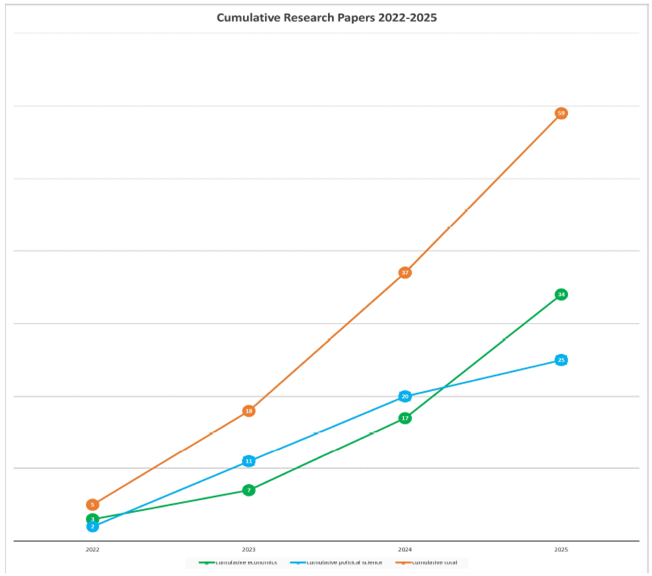
| Year | Total No. of Publications |
| 2022 | 5 |
| 2023 | 13 |
| 2024 | 19 |
| 2025 | 22 |
| Name | Article |
| Prof. Ola ElSayed | Ola Al Sayed and Shadwa Esmat (2022), Willingness to Pay for Digital Government Services in Egypt: A Contingent Valuation Analysis for Electricity Meter Case, International Journal of Public Policy in Egypt, Vol. 1, No. 4, p.p. 133-162. |
| Ola Al Sayed, Noha Sami, and Abdelmoneam Khalid (2022), The Impact of Institutions Quality and Information Availability on Capital Inflow Volatility in Selected MENA Region, Review of Economics and Political Science (REPS), Vol.7. | |
| Prof. Ola Al Sayed & Dr. Maie Ashraf
|
Ola Al Sayed and Maie Ashraf. (2024), Financing Sustainable Development Goals (SDGs): The Role of Fintech in Closing Financing Gap, A review paper, in International Conference on Advancing Sustainable Futures (ICASF 2023), Abu Dhabi University, 5th and 6th of December, UAE, 2023. (Under reviewing for publication) |
| AlSayed, O., & Ashraf, M. (2025). Financing Sustainable Development Goals (SDGs): The Role of FinTech in Closing Financing Gap. المجلة العلمية للإقتصاد و التجارة, 55(2), 171-222. | |
| Prof Ola ElSayed, Dr AbdelGhaffar & Dr Salwa Abdelaziz | Abdelaziz, S., Al Sayed, O., Abdelazeem, D., & Abdelghaffar, R. A. (2025). The impact of macroeconomic indicators on working capital management and firms’ profitability in Egypt. Journal of Economic and Administrative Sciences, 1-22. |
| Dr Amira Ragab | El-Sady, Hassan, Amira Ragab, and Dina Mohsen. “The Mediation Effect of Country Risk in the Nexus Between Stock Market Development and Economic Growth: Evidence From
Developing Countries.” International Journal of Financial Research 13.2 (2022): 36. |
| Dr Ebtisam Hussein | Hussein,E. (2022). Algerian Post-Bouteflika Democratisation and EU Security Implications, ENC |
| Hussein, E. (2024). Ten Years After: Revisiting the Ouster of Egypt’s Muslim Brotherhood. Middle East Policy, 31(2), 124-135. | |
| Hussein, E. (2024). EU Counter-Terrorism Efforts & MENA Violent Extremism: Did the EU Help MENA Countries Enhance their Security?, ENC | |
| Hussein, E., & Karagiannis, E. (2024). Regime continuity and Islamists’ limited opportunities in post-2019 Algeria and Sudan. British Journal of Middle Eastern Studies, 51(5), 937-953. | |
| Dr Mazen Hassan & Dr Sara Mansour | Mansour, Sarah and Hassan, Mazen and Voigt, Stefan and Amin, Engi, Using Discourse to Incentivize Cooperation in Arab-Muslim Culture: Experimental Evidence from Egypt (April 14, 2022). Available at SSRN: https://ssrn.com/abstract=4083772 or http://dx.doi.org/10.2139/ssrn.4083772 |
| Dr Rawia Tawfik | Tawfik, R. (2023). Regional mediation in African transboundary rivers conflicts: Assessing the African Union’s role in the Renaissance Dam negotiations. International Negotiation, 29(3), 536-565. |
| Tawfik, R. (2023). Migration Policies and Regional Integration: The Case of Migration between Egypt and Sudan. Hikama, 4(7). | |
| Dr Heba Ashraf | Mekawy, Heba “Development of the Payment Systems: An Economic Need or a Technological Deed,” Future Journal of Social Science: Vol. 1: Iss. 2, Article 4 |
| Dr. Asmaa Ezzat | Ezzat, A., & Zaki, C. (2025). An empirical assessment of the nexus between competition policy and Global Value Chains (No. 6). Sustainable Global Supply Chains Discussion Papers. |
| Ezzat, A., & Emira, M. (2025). Do institutions matter in the fiscal reaction function? The case of Egypt. Humanities and Social Sciences Communications, 12(1), 1-15. | |
| Dr Marwa ElSherief | Elsherif, M. (2024). Modelling inflation dynamics and global oil price shocks in OAPEC countries: TVP-VAR. International Journal of Energy Economics and Policy, 14(3), 51–69. |
| Amin, M., El-Din, A. S., & Sherif, M. (2024). An Examination Of Impact Of Regulation Efficiency On Foreign Direct Investment: The Role Of Institutional Quality In Mena Region From (2000-2020). Open Journal Of Social Sciences, 12(8), 380-404. | |
| Amin, M., Salah El-Din, A., & El Sherif, M. (2024). An Examination of impact of infrastructure on Foreign Direct Investment: The Role of Institutional Quality in MENA Region from (2000-2020). المجلة العلمية للدراسات التجارية والبيئية, 15(3), 306-340. | |
| M. Elsherif, “Nexus between Blue Economy, Renewable Energy and Environmental Sustainability in the MENA Region: Evidence from Panel Threshold Regression,” Int. J. Energy Econ. Policy, vol. 14, no. 4, pp. 169–185, 2024 | |
| Assem Ali Mohamed El Shamy, M., Salman, D., & El Sherief, M. (2025). The Effect Of E-Banking On Bank’s Profitability In Egypt. المجلة العلمية للدراسات التجارية والبيئية, 16(2), 992-1015. | |
| Hussein, M.S., Kamal, M., Salah, A., Moussa, S., Elhawary, S., Elsherif, M., Al-Dahshan, M., Elsherif, N., AboElsoud, A., Said, A. and Al-Shahid, M., 2025. Strategic Planning Role in the Proper Implementation of Medicolegal Responsibility Laws. Egyptian Journal of Hospital Medicine, 98(1). | |
| Assem, M., S Abouzaid, A., & ElSherif, M. (2025). Financial Risks and Bank Performance A Literature Survey of Credit and Liquidity Risk in listed Egyptian Banks. المجلة العلمية للدراسات التجارية والبيئية, 16(2), 4548-4560. | |
| Maher Fahim, M., Elsherif, M., & Abed, M. (2025). Oil Price-Exchange Rate Dynamics in Egypt: An ARDL Bounds Testing Approach to Understanding Macroeconomic Relationships in Emerging Markets (1990-2023). المجلة العلمية للدراسات التجارية والبيئية, 16(3), 1668-1695.
|
|
| Dr Doaa Wafik | Ausat, A. M. A., Shafiq, M. A., Wafik, D., & López, N. A. S. (2024). The role of transformational leadership in improving employee psychological wellbeing: A review. Apollo: Journal of Tourism and Business, 2(1), 148-157. |
| BadriyahN., AusatA. M. A., ShafiqM. A., WafikD., & MazilM. M. (2025). Unlocking Job Performance: How Servant Leadership, Psychological Safety, and Organizational Justice Drive Success Through Organizational Trust. Journal Aplikasi Bisnis Dan Manajemen, 11(2), 404. https://doi.org/10.17358/jabm.11.2.404 | |
| Wafik, D., & Tharwat, A. (2025). Correlation Between Gdp And Unemployment Rate: Case Study Usa (No. hal-05364255). | |
| Dr. Salwa Abdelaziz | “Taghreed Hassouba , Nagwa Samak2 , Sania Amin Nayel3 , Salwa AbdelAziz (2023) ”The Macroeconomic and Institutional Determinants of Sovereign Credit Rating: Empirical Evidence from Emerging Countries (1998-2020)” المجلة الدولية للسياسات العامة في مصر, مجلد 2 العدد 3, يوليو 2023” |
| “Salwa Abdel Aziz1, Hoda Mansour and Solaiman Hassan (2023)” Mobile Data Internet Costs and E-shopping Frequency: Evidence from Seven Regions” Review of Economics and Finance, 2023, 21, 2867-2879. “ | |
| “Salwa Abdelaziz, Asmaa Mohamed ( 2025) “ Determinants of demand for wheat imports in Egypt during the period (1980-2020) and the possibility of achieving food security from it in the coming years” FEPS journal , vol 26, No 3 2025.” | |
| “Eslam A. Hassanein 1,2, Nagwa Samak2,3 & Salwa Abdelaziz2 “The synergetic effect of economic complexity and governance on quality of life: policy thresholds” (2025 ) HUMANITIES AND SOCIAL SCIENCES COMMUNICATIONS | https://doi.org/10.1057/s41599-024-03577-2.” | |
| ” Abdelaziz, S. M.; Samak, N.; Abdelsalam, M. A. M.; Sobhy, M. W. and Ahmed, F. (2025). The Impact of Exchange Rate Volatility on Foreign Direct Investment Inflows the Case of Egypt, Scientific Journal for Financial and Commercial Studies and Research, Faculty of Commerce, Damietta University, 6(1)1, 407-445.” | |
| Dr Radwa Abdelghaffar | Abdelghaffar, R. A., Emam, H. A., & Samak, N. A. (2023). Financial inclusion and human development: is there a nexus?. Journal of Humanities and Applied Social Sciences, 5(3), 163-177. |
| Dr Mazen Hasan | Hassan, M., Amin, E., Mansour, S., & Nicklisch, A. (2023). Did the Arab Spring generate affective polarization? Experimental evidence from five Arab countries. Democratization, 30(4), 569–594. |
| Incentivizing cooperation against a norm of defection: Experimental Evidence from Egypt, Journal of Behavioral and Experimental Economics, Volume 107, 2023, pp.102121. https://doi.org/10.1016/j.socec.2023.102121.
|
|
| Dr Ghada Moussa | Critique of “the Austrian School of Economics’ Liberalism”, 2023, Helwan University |
| Mechanisms for Adaptation and Preparation for the stage of Multiple Global Risks, focusing on the Egyptian Case, 2023, Al Ahram Center for Political and Strategic Studies. | |
| Towards the Right to the Access of Information: Between National legislations and International Agreements, 2023, ARADO | |
| The Role of the Governance of Universities In Achieving Social Justice, 2023, ARADO | |
| The Paradoxes of the Welfare State in Egypt: Constructing a Welfare State through Legitimacy,2024, Alexandria University | |
| The role of value creation in achieving good governance and combating corruption in the “New Republic” in Egypt, 2024, Suez University | |
| The Paradoxes of the Welfare State in Egypt: Constructing a Welfare State through Legitimacy,2024, Alexandria University | |
| The role of value creation in achieving good governance and combating corruption in the “New Republic” in Egypt, 2024, Suez University | |
| Dr Ola Abouelamaym | Salah, R. and Abuelamayem, O. (2025). Partially Accelerated Dependent Competing Risks Model under Adaptive Type-II Progressive Censoring Based on Copulas. The Egyptian Statistical Journal. 69(1), 103-126. |
| Abuelamayem , O. A. (2025). A Deep Inverse Weibull Network. Statistics, Optimization & Information Computing. 13(4), 1357-1367. | |
| Dr Hoda Shaltout | Shaltout, HF. (2025) “The 2015 Mediterranean migration crisis and European Human rights values: security comes before R2P” “. مجلة كلية السياسة والاقتصاد، جامعة بني سويف، |
| Shaltout, Hoda (2025) The Neoclassical Realist Face of the UAE’s Foreign Policy towards the Sudanese Crisis. Published by the Athens Institute: Working Paper No. 2025-2789-34, 20 November 2025. Pages 1-18. | |
| Dr Rasha ElBaz | An Analysis Of China’s Foreign Relations And Their Global Impact. المجلة الجزائرية للسياسة و الأمن Volume 3, Numéro 1, Pages 09-37 |
| Great powers competition in Africa current challenges and future scenarios https://sjcf.journals.ekb.eg/article_396739.html | |
| Great power competition in Central Asia: current challenges and future scenarios https://jocu.journals.ekb.eg/article_402541.html | |
| Environmental Diplomacy in Egyptian Foreign Policy (2015-2023): Challenges and Opportunities. | |
| Ms.Nouran Tawheed | Rashwan, M. M., Tawheed, N. M., & Gad, A. M. (2025) Imputation Methods Based on Cluster-Wise Linear Regression: A Mathematical Programming Approach, Journal of Statistical Theory and Applications, 1-16, https://doi.org/10.1007/s44199-024-00095-7 |
| Ms Rania Moaz | Moaaz, R. S. (2022, December). The role of the financial sector and governance in promoting formal entrepreneurship in the mena region. Economic Research Forum (ERF).
|
| Ms. Mariam Hegazy | “A Comparative Study for Survival Prediction of NKI Data Using Statistical and Machine-Learning Approaches” (with Prof. Ahmed Gad, Dr Niveen ElZayat, Dr Mahmoud Rashwan and Dr Amal Sakr) published in 2024 6th Novel Intelligent and Leading Emerging Sciences Conference (NILES) Proceedings, Giza, Egypt, 2024, pp. 269-273, doi: 10.1109/NILES63360.2024.10753226. |
| “The Influence of AI Chatbots in Fintech Services on Customer Loyalty within the Banking Industry” (with Dina El Shihy, Noha Hamza and Mohamed AbdelRaouf) published in 8th International Conference on Research in Management and Economics Cambridge Conference Proceedings. It was published later in Future business Journal http://dx.doi.org/10.33422/fba.v3i1.644 |
Portfolio
Each student’s portfolio is an integral part of the assessment strategy of the School of Economics and Politics. A portfolio includes graded and un-graded work like research projects, quizzes, assignments, and relevant activities in addition to a self-reflection report that reflects on the learning experience of the student throughout the course. The submission of a satisfactory portfolio at the specified due date is compulsory.
Student Support System
Students enjoy a high standard of student support system, both on the university level, through student affairs, as well as on the school level, through a friendly academic advising system, where each staff member is responsible for a small group of students throughout their whole stay within the school to guide, advise and mentor them whether academically, professionally or socially.
Internships
- Egyptian Competition Authority (2025)
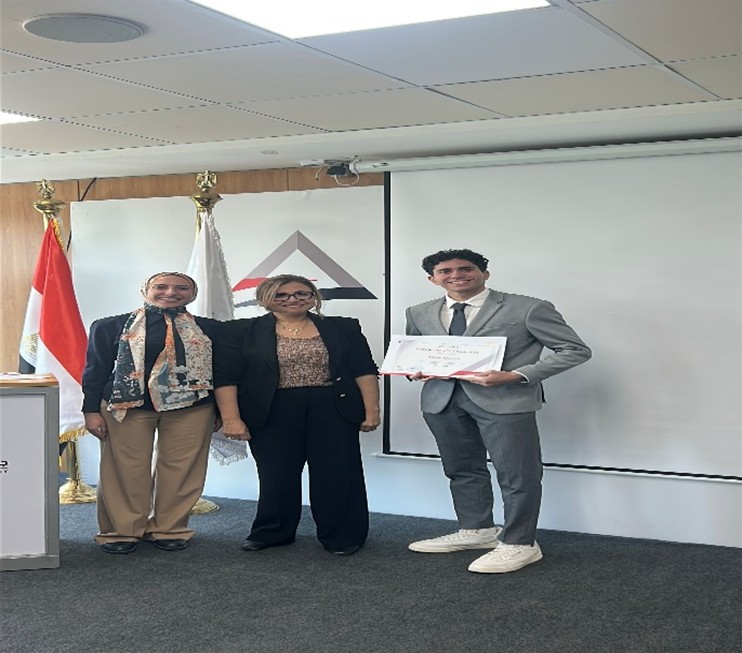
- Financial Regulation Authority (2022-2025)
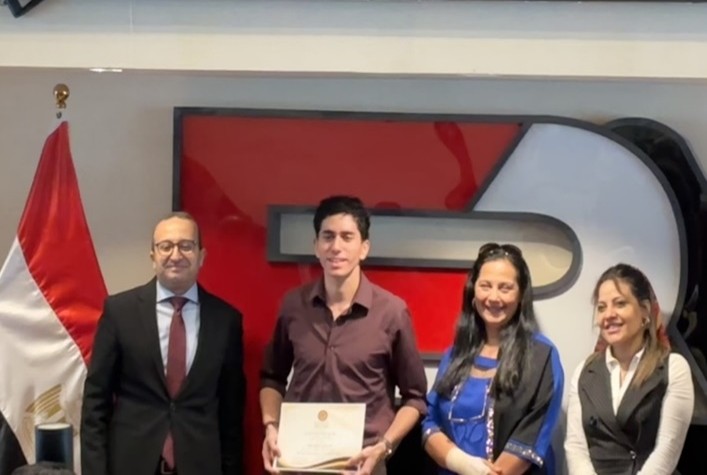
- League of Arab States (2025)
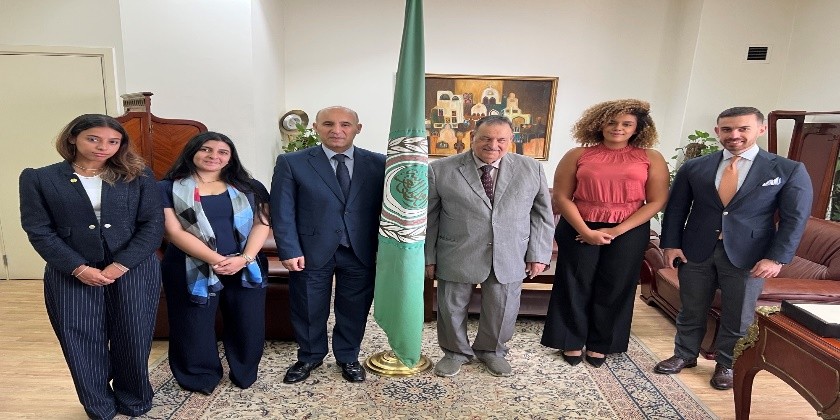
- Egyptian Exchange (2025)
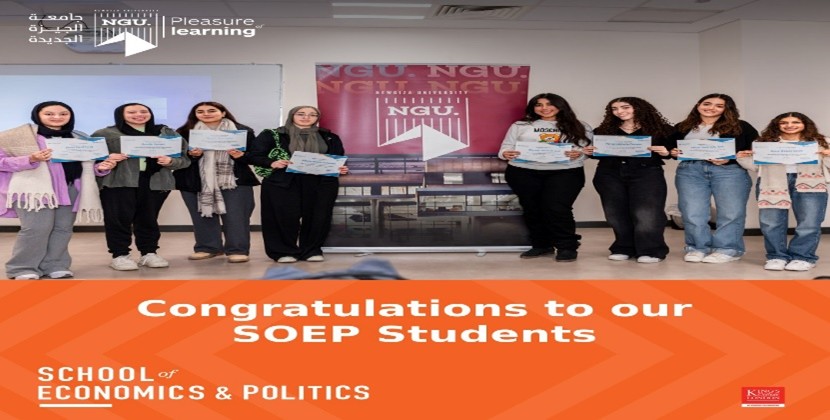
- HSBC Internship (2024)
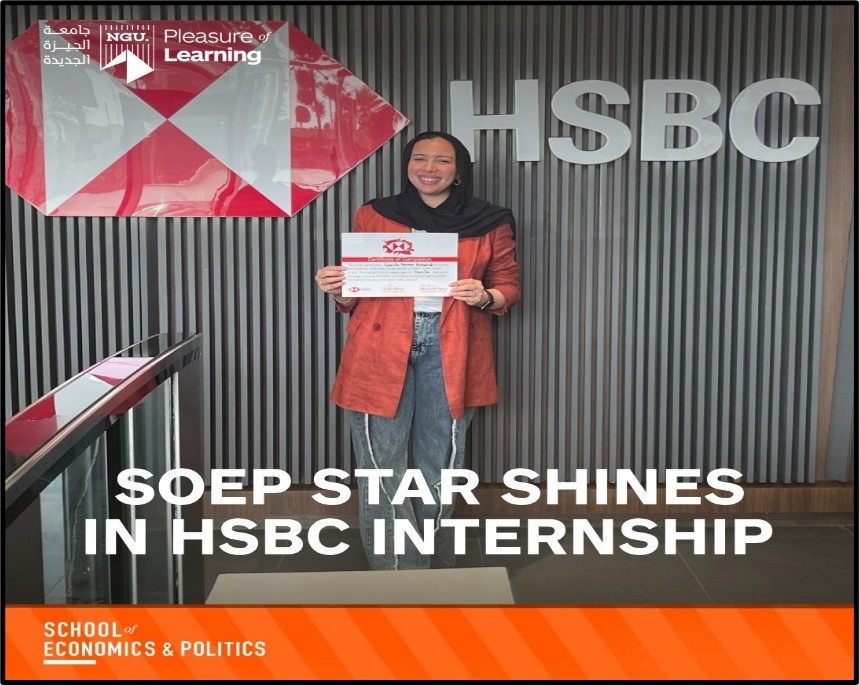
- Ezz Steel (2023)
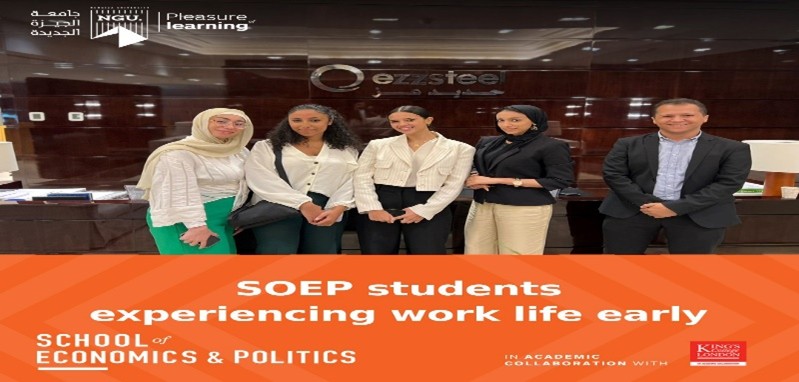
- Banque Du Caire Internship (2023)
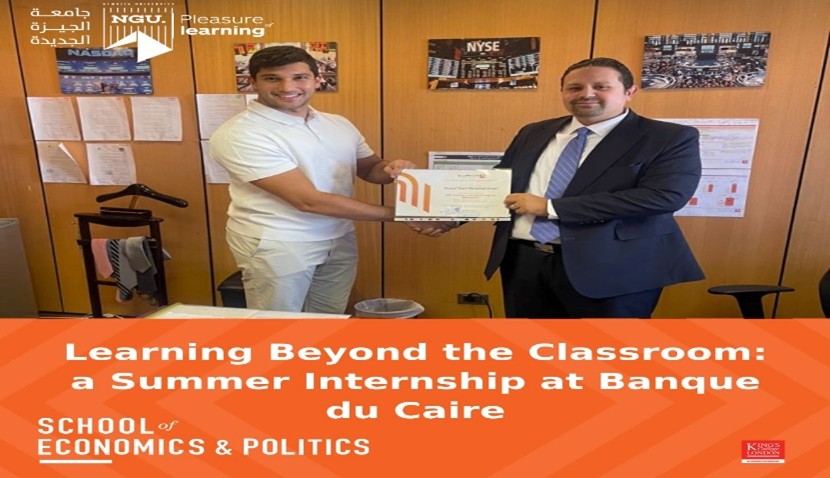
Student Activities
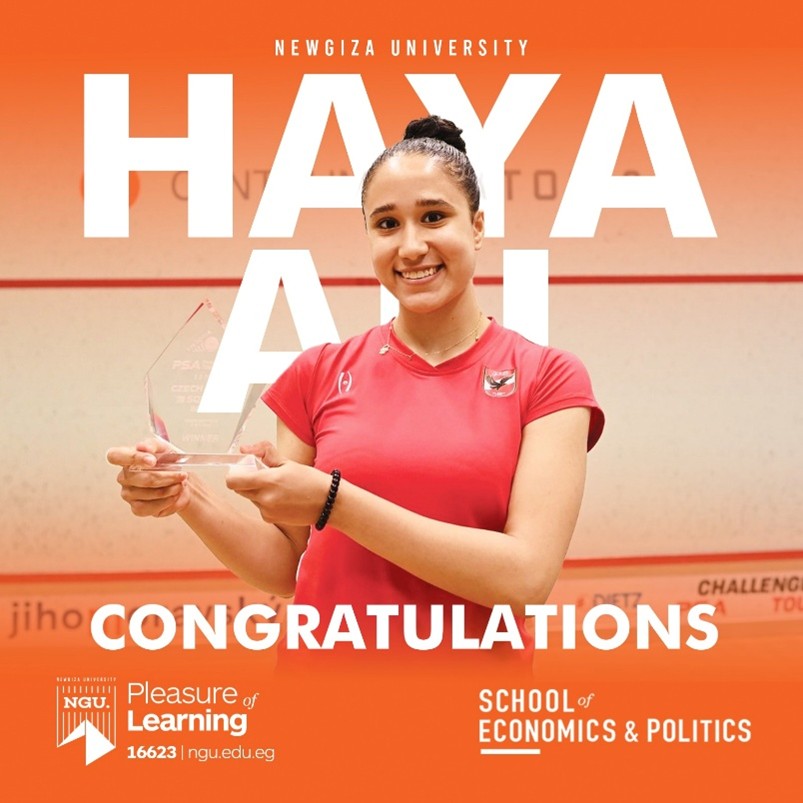
- Championships (Squash & Tennis) (2025-2026)
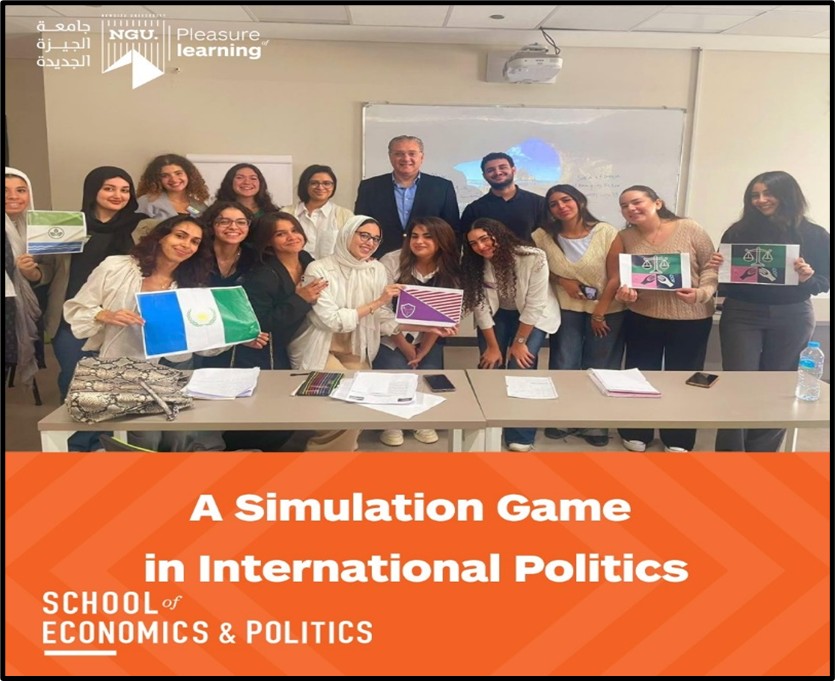
- A Simulation Game in International Politics (2024)
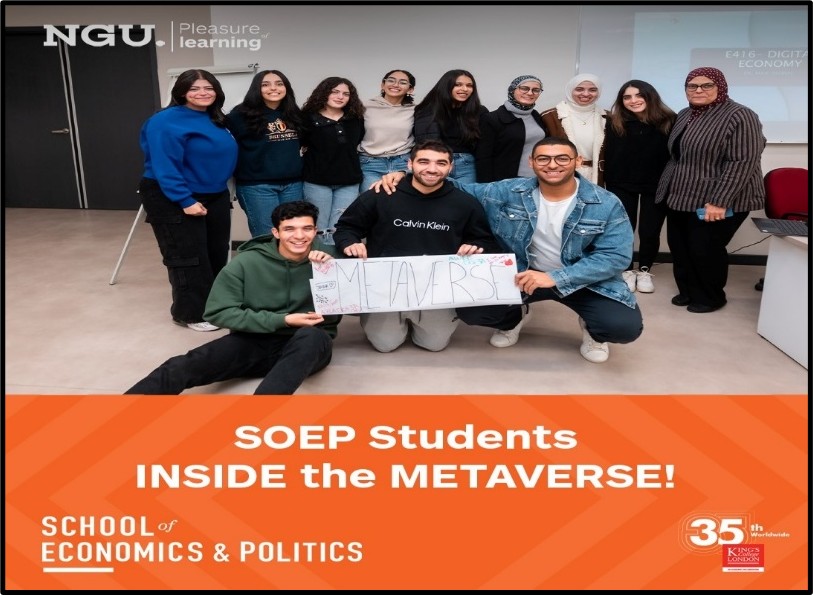
- A Simulation on the Future of the Digital Economy and the Metaverse (2024)
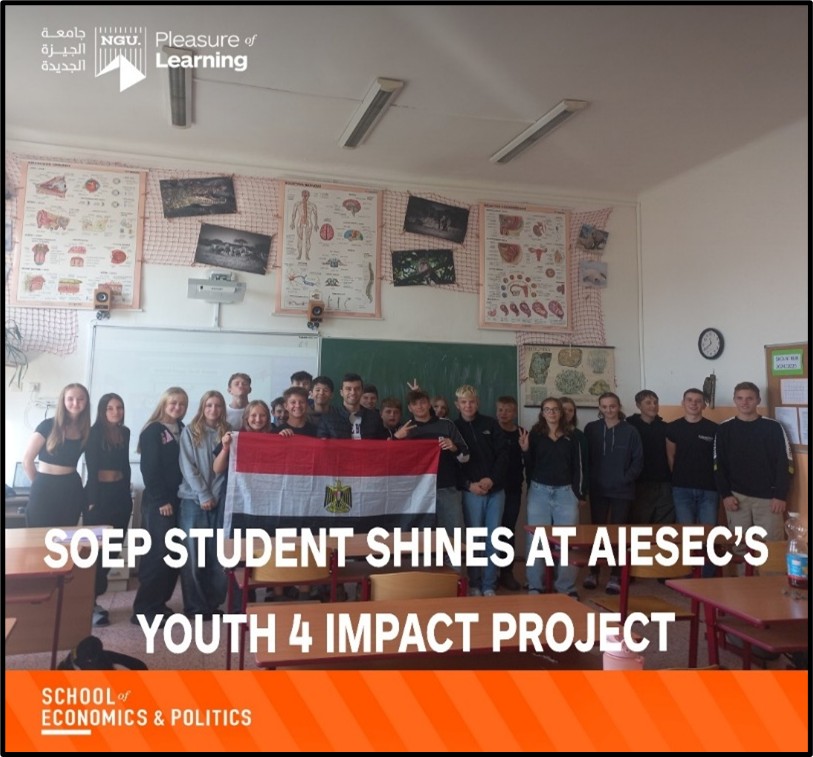
- AISEC “Youth 4 Impact” Project (2024)
Community Service
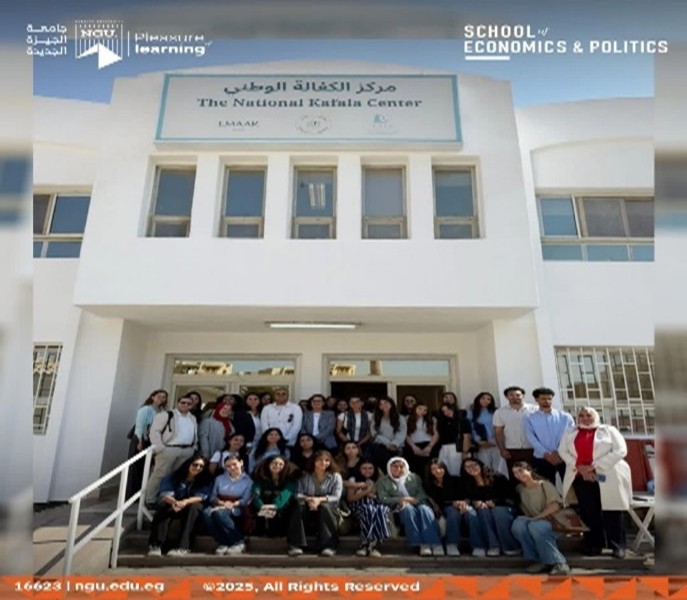
- National Kafala Center Visit (2025)
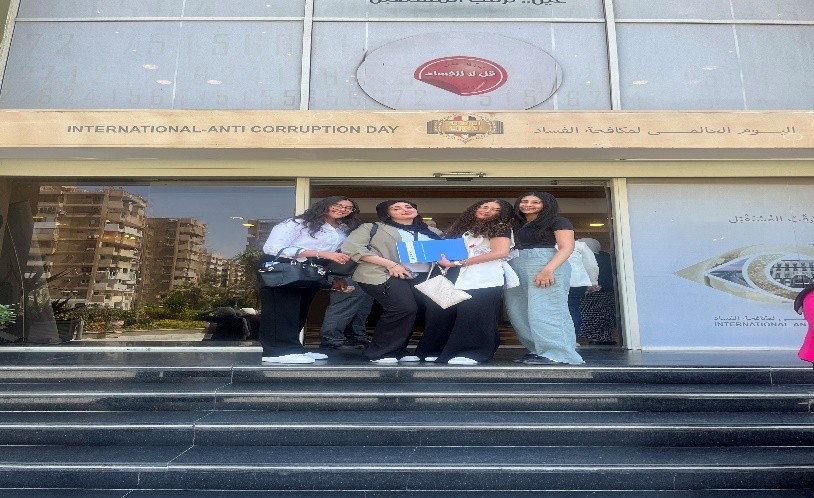
- National Anti-Corruption Academy Visit (2025)
SOEP Newsletter
- The School of Economics and Politics students visit the League of Arab States, 28 Dec 2025. Read the full story here.
- The School of Economics and Politics organized a seminar on ECA simulation, 17 Dec 2025. Read the full story here.
- The School of Economics and Politics organized a seminar on Monitoring and Evaluation by Salma Sabry, 11 Dec 2025. Read the full story here.
- The School of Economics and Politics students visit the Institute for Diplomatic Studies. 15 Nov 2025. Read the full story here.
- The School of Economics and Politics organized a seminar on “Routes to Inclusive Higher Education” by Dr. Mostafa Attia, 20 Oct 2025. Read the full story here.
- The School of Economics and Politics students visit Alashanek Ya Balady NGO. 15 May 2025. Read the full story here.
- The School of Economics and Politics students visit the Egyptian Parliament, 10 Apr 2025. Read the full story here.
- A day of deep insights at the Arab League, 9 Jan 2024. Read the full story here.
- Unveiling the future: exploring the Central Bank Digital Currencies (CBDCs), 2 Jan 2024. Read the full story here.
- NGU students at the National Council for Human Rights (NCHR), 19 Dec 2023. Read the full story here.
- NGU at the Institute for Diplomatic Studies, 17 Dec 2023. Read the full story here.
- The School of Economics and Politics’ students continue to make their mark in the world of finance, 4 Dec 2023. Read the full story here.
- The Egyptian Competition Authority seminar unveils opportunities for the School of Economics and Politics students, 24 Oct, 2023. Read the full story here
- The School of Economics and Politics organized a lecture by Dr. Sara Adel Mansour, Associate Professor of Economics, to deliver a lecture on: Economics in Reality, May 25, 2023. Read the full story here.
- The School of Economics and Politics invited Amb. Dr. Sallama Shaker to deliver a lecture on: Power Rivalry and Global Disorder, May 24, 2023. Read the full story here.
- The School of Economics and Politics hosted a lecture by International Disability Inclusion Consultant, Dr. Mostafa Attia, titled: Inclusion: How and Why it Matters?, May 10, 2023. Read the full story here.
- The School of Economics and Politics invited Amb. Dr. Sallama Shaker to deliver an intriguing lecture on: War by Other Means, Dec 19, 2022. Read the full story here.
- The School of Economics and Politics was honored to organize a lecture by Amb. Abd Al-Rahman Salah Al-Din Ali on: The Russian-Ukrainian War, Nov. 13, 2022. Read the full story here.
- The School of Economics and Politics was honored to organize a lecture by Amb. Moushira Khattab, President of the National Council for Human Rights and Former Egyptian Minister for Family and Population, Nov 3, 2022. Read the full story here.
- In collaboration with the Egyptian Exchange EGX, an event was organized under the title: Ringing the Bell for Financial Literacy Initiative, Oct. 10, 2022. Read the full story here.
- The School of Economics and Politics invited Amb. Dr. Sallama Shaker to deliver a lecture on: Challenges of Diplomacy in a Global Era. June 7, 2022. Read the full story here.
- A Round table was held between the School of Economics and Politics (SOEP) and the School of Information Technology (SOIT), attended by Dr. Hala Sakr, Dean of the SOEP, and Dr. Samhaa Al-Beltagy, Dean of the SOIT, about: Artificial intelligence and its Implications on the Economy, April 12, 2021. Read the full story here.
- The School of Economics and Politics invited Ms. Shahira Diab, Managing Director of La Poire Group, to a live Webinar on 9th of June 2021, to share her success story in the business world. Read the full story here.
- The School of Economics and Politics organized an online webinar about the future of job opportunities in the tourism sector by Prof. Adla Ragab, Prof. of Economics-Faculty of Economics and Political Science, and Director of the Center for Economics and Financial Research at Cairo University, April 6 2021. Read the full story here.
- The School of Economics and Politics organized a study visit to the Egyptian Parliament in the framework of the course on the Egyptian Political System, Dec 23, 2019. Read the full story here.
- The School of Economics and Politic invited Ms. Manal Maher, Member of the Egyptian Parliament, to give a talk on: The Role of the Parliamentarian: A Real Perspective, November 12, 2019. Read the full story here.
Alumni
ALUMNI OFFICE
Vision
To establish a dynamic and globally engaged alumni community for the NGU School of Economics and Politics that strengthens the school’s reputation and academic standing, and actively contributes to the professional, academic, and societal development of its graduates and the broader community.
Mission
The Alumni Office fosters a strong and active community for the School of Economics and Politics by maintaining graduate engagement through communication, events, and networking. It supports alumni career development via mentorship and professional training, showcases their achievements to enhance the school’s visibility and accreditation profile, and involves them in academic, research, and community initiatives. The office also tracks alumni impact to continuously improve programs and support institutional goals.
Alumni Booklet:
Alumni Booklet (2023-2025)
Entrance Requirements
Fall 2026 Entrance Requirements – School of Economics and Politics
For more details, please refer to the admissions section.
Tuition Fees & Deadlines
Tuition Fees:
School of Economics and Politics tuition fees for the academic year (2025-2026): EGP 208,600 for Egyptian students. For more information, please click here.
Deadlines:
The deadline for the academic year 2025/2026 will be announced soon.
Apply Now
Fill out the online application form.
For admissions inquiry, please contact 16623, or email enrollment@ngu.edu.eg